Decision made. I am making a return visit to Japan!
I had a long chat with Jill Clay of Festival of Japan when I was at Festival of Quilts in August, and since then I have studied the website, asked a lot of questions, considered my finances and tried to persuade dearly beloved that he would enjoy a textile-based trip to Japan! Al decided against the trip, I think he would rather make another visit to New Zealand, but I really want to go, and Jill's itinerary sounds fantastic, plus she only has small groups, so I've reserved my place on the Autumn Maples and Textiles visit in 2017.
I'll have thirteen nights based in Kyoto with a host of activities and visits that I'm sure I don't have the connections or the language skills to arrange for myself.
It's a long way off and I don't have exact dates yet but when I do I will decide whether to extend my trip and visit friends in Tokyo. I've also sent the details to my sister, now she is no longer teaching she has time to travel and I think she might be up for the trip. Golly, could we share a bedroom again, it's been about 50 years!!?
Before then, however, Al and I have had 25 years together and it's time to celebrate. We're soon taking off for a lazy holiday in Akumal Bay, Mexico.
Showing posts with label Japan. Show all posts
Monday, 26 September 2016
Sunday, 4 September 2016
Gentle Stitching
Today I have begun work on a printed panel I bought in Japan in 2009. Just gentle hand stitching, very relaxing. I am in the process of deciding to make another trip to Japan, hopefully next year, so the contemplative sewing is perfect. Hoping the weekend has been good for you all. It's back to school for children (and teachers) this week.
Saturday, 23 April 2016
The Continuing Life of a Boro
I must first declare that I am prepared for thunderbolts and criticism...
I bought a boro cloth from Japan. For a while I admired the history of the piece, the poverty of working people that led to repeated repairs and patching of textiles, the elegantly fading indigo, the large hand stitching.
I have done a lot of houseclearing lately, and this made me consider what my children think of the tatty blue fabric? Sara will know what it is but I can't imagine she'd want to give it house room. So, I am giving it a new life, as sympathetically as possible but it still involves....SCISSORS!!
I started by cutting a large section of the cloth, about 6'x3', and hemmed it using cotton thread I dyed with indigo in Fujino four years ago. I used big, soft stitches. This section will become a wall hanging, so that I can enjoy it everyday. The sides I stitched in sashiko thread, echoing the stitching on the edges of the cloth. The thread will become less bright with time.
The next stage is to patch and repair the textile. I have the tattiest end of the boro cloth to harvest for that.
The fabric I cut from the width has made a lovely runner for the bed (or a table), this section has few repairs.
Tuesday, 12 January 2016
A New Year, A New Toy
Lynda Monk was having a clear out, as we all do at this time of the year. I am now the excited owner of one of these
although it will be a very long time before I have that many bobbins on my kumihimo maradui. Here's a short video to show you the basic idea:
I did a little kumihimo weaving when I was in Japan, I've found the posts and then spent quite a while looking back through photographs and feeling very nostalgic for my Indigo Sisters, Bryan, the other lovely people I met in Japan, and the whole experience of the Japanese Textile Study Tour in 2012.
So, one of the things I do this year will be to weave some braids. Lynda sent me three books of instruction and inspiration too and I shall look forward to my first opportunity to go shopping for threads! I remember enjoying the rhythmic "click, clack" of the bobbins when I was in Japan, so soothing although a lot of concentration is required.
I am currently trying to decide whether to commit to the Contemporary Group's Journal Quilt challenge again this year. The quilts are to be larger, 8"x10" portrait, and there are rules concerning colours. I am pondering. Other exciting happenings include the quilt we are making at Country Roads Quilters which will be entered in FoQ this year and the current techniques swap we are having at Global Piecers, foundation piecing this month. There's a lot to look forward to, plus a forecast of snow later this week, finally it might be Winter!
Sunday, 1 June 2014
As Promised...
... here are pictures of what was in my parcel from Japan. Three silk haori, all with shibori dyeing. The turquoise one was listed as being "mis-dyed" and I suppose that's what the odd coloured patches are. I bought it thinking I could at least use most of the fabric but I love it as it is, the blotches are part of its story, and will keep it whole and wear it.
I must get some better hangers for showing off my Japanese garments. Secondly, a lovely summery shade but with a chrysanthemum design.
Finally, a lovely black haori with shibori and a little goldwork embroidery.
Several blogs I follow are showing off red at the moment, here are my contributions:
http://onesmallstitch.wordpress.com/2014/05/31/more-red/
Labels:
haori,
Ichiroya Kimono Flea Market,
Japan,
shibori
Wednesday, 14 May 2014
Flying the Flags
I am very excited as I have finished the prayer flags for the Global Piecers' swap. The sun came out this afternoon and I was able to hang them in the garden before packaging them up and sending them flying off around the world. I've used one of the photos as my new header! I know I promised to share my progress with these pieces but I have been so inspired by them (and the weather has been so wet) that I have been sewing almost continuously since I started.
I'm obviously not going to say which flag is going to which lovely lady but they can have fun guessing. Written on each flag are words summarising my prayers for each person. Here's a close-up of one of the flags:
The prayer flags are all similar in style and make up. In in my previous post I explained that I wanted to use global fabrics for the Global Piecers. In this flag you can see persimmon-dyed linen from my sensei in Japan, eco-dyed silk that I dyed in Japan (using materials collected at the foot of Fuji san), batik fabric from Africa and the zebra button was made in South Africa, there are small pieces of vintage kimono silk, some of the streamers are recycled sari silk from India and the lace is from Malta. The flags are all hand stitched, except for one line of machine stitching to attach the streamers.
Slow stitching! As I said above I have been stitching by hand, hour after hour, day after day. These flags hold my prayers, in some cases my tears but I hope I avoided adding my blood. My fingers are severely punctured. I wish I could get on with a thimble but I can't and some of the fabrics, especially the batiks and the kimono silk felt as if I was sewing through concrete. At one point the fat end of a sashiko needle, complete with perle thread, was embedded in my middle finger! I got through seven needles. I don't mind a bit.
I hope the ladies like their prayer flags, I have loved making them and I must add a big thank you to Angela Daymond. It was during her slow stitch workshop a couple of weeks ago that I realised what we were doing with her was perfect for making the prayer flags, thanks Angela. I'm now looking forward to receiving my prayer flags from around the world and hanging them in my garden, more photos will follow, and have just heard that one lady is planning to string her flags under her avocado tree!! Wow, I'd love an avocado tree! I do recall growing a stone, supported over water by cocktail sticks, many years ago. It did shoot, grew about three inches and then died. Maybe it's time to try again.
I'm obviously not going to say which flag is going to which lovely lady but they can have fun guessing. Written on each flag are words summarising my prayers for each person. Here's a close-up of one of the flags:
The prayer flags are all similar in style and make up. In in my previous post I explained that I wanted to use global fabrics for the Global Piecers. In this flag you can see persimmon-dyed linen from my sensei in Japan, eco-dyed silk that I dyed in Japan (using materials collected at the foot of Fuji san), batik fabric from Africa and the zebra button was made in South Africa, there are small pieces of vintage kimono silk, some of the streamers are recycled sari silk from India and the lace is from Malta. The flags are all hand stitched, except for one line of machine stitching to attach the streamers.
Slow stitching! As I said above I have been stitching by hand, hour after hour, day after day. These flags hold my prayers, in some cases my tears but I hope I avoided adding my blood. My fingers are severely punctured. I wish I could get on with a thimble but I can't and some of the fabrics, especially the batiks and the kimono silk felt as if I was sewing through concrete. At one point the fat end of a sashiko needle, complete with perle thread, was embedded in my middle finger! I got through seven needles. I don't mind a bit.
I hope the ladies like their prayer flags, I have loved making them and I must add a big thank you to Angela Daymond. It was during her slow stitch workshop a couple of weeks ago that I realised what we were doing with her was perfect for making the prayer flags, thanks Angela. I'm now looking forward to receiving my prayer flags from around the world and hanging them in my garden, more photos will follow, and have just heard that one lady is planning to string her flags under her avocado tree!! Wow, I'd love an avocado tree! I do recall growing a stone, supported over water by cocktail sticks, many years ago. It did shoot, grew about three inches and then died. Maybe it's time to try again.
Thursday, 13 March 2014
Boro in London
http://www.somersethouse.org.uk/visual-arts/boro
"This April Somerset House will host an exhibition on the Japanese textile tradition of boro. Translated to ‘rags’ in English, boro is the collective name for items – usually clothing and bed covers – made by the poor, rural population of Japan who could not afford to buy new when need required and had to literally make ends meet by piecing and patching discarded cotton onto existing sets, forming something slightly different each time they did so. Generations of Japanese families repaired and recycled fishermen’s jackets to futon covers, handing them down to the next and weaving their own sagas and stories through the threads.
"As such boros are seen to have significant sociohistorical status by providing an insight into the modest lives of those that made them and a snapshot of the country’s impoverished past, but they can also be viewed as articles of great artistic value. Consciously or otherwise, the once humble objects can be considered works of art with their unique arrangements of shapes and beautiful hues of blues and browns, reminiscent of the paintings of Paul Klee or the combines of Robert Rauschenberg. In this context, Boro will showcase 40 historic boro pieces in a new light within Somerset House’s East Wing Galleries from a collection never before displayed and compiled over six years by antiquarians Gordon Reece and Philippe Boudin."
Gordon Reece opened a gallery in Knareborough and another in Mayfair and promoted the appreciation of non-European crafts. The galleries closed in 2007.
Philippe Boudin is the director of the Mingei Arts Gallery in Paris.
I am planning to see this exhibition and will, of course, report back. In the meantime, pop over to Susan Briscoe's blog where she has shared some of her own collection of boromono and a lot of information about these evocative textiles.
"This April Somerset House will host an exhibition on the Japanese textile tradition of boro. Translated to ‘rags’ in English, boro is the collective name for items – usually clothing and bed covers – made by the poor, rural population of Japan who could not afford to buy new when need required and had to literally make ends meet by piecing and patching discarded cotton onto existing sets, forming something slightly different each time they did so. Generations of Japanese families repaired and recycled fishermen’s jackets to futon covers, handing them down to the next and weaving their own sagas and stories through the threads.
"As such boros are seen to have significant sociohistorical status by providing an insight into the modest lives of those that made them and a snapshot of the country’s impoverished past, but they can also be viewed as articles of great artistic value. Consciously or otherwise, the once humble objects can be considered works of art with their unique arrangements of shapes and beautiful hues of blues and browns, reminiscent of the paintings of Paul Klee or the combines of Robert Rauschenberg. In this context, Boro will showcase 40 historic boro pieces in a new light within Somerset House’s East Wing Galleries from a collection never before displayed and compiled over six years by antiquarians Gordon Reece and Philippe Boudin."
Gordon Reece opened a gallery in Knareborough and another in Mayfair and promoted the appreciation of non-European crafts. The galleries closed in 2007.
Philippe Boudin is the director of the Mingei Arts Gallery in Paris.
I am planning to see this exhibition and will, of course, report back. In the meantime, pop over to Susan Briscoe's blog where she has shared some of her own collection of boromono and a lot of information about these evocative textiles.
Friday, 14 February 2014
Monday, 17 June 2013
WIPs
I've been quietly working on two pieces of stitching, both of which stem from my trip to Japan last year (how long ago that seems now). The boro cloth is made up of lots of sample pieces of the various techniques we learned with Bryan and the silk panel was dyed using material found at Fuji-san and is embroidered with threads given to me by my friends in Japan. They are both pieces full of memories and I am enjoying creating them. There is no rush, just a few stitches at a time. Today I hope to have the plaster cast removed from my foot and, if healing is progressing well, I shall be more mobile. The healing is like the stitching, a project, patience is required and I cannot be in a rush.
Labels:
boro,
Bryan Whitehead,
Indigo Sisters,
Japan,
Mount Fuji
Monday, 15 April 2013
New Boro
Today I started making my own boro cloth. Not by repairing something I already have but by combining sample pieces of indigo dyeing done by my Indigo Sisters and me, pieces collected when I was in Japan this time last year.
Judi brought pieces she had dyed in various shibori designs at home, Nat dyed indigo moons, Carin gave me a sashiko piece to stitch in my spare time (ha ha), Blandina gave me silk threads, we all cut our own katazome stencil and dyed sample pieces. It seems appropriate to join all these together, with hand stitching, to make a souvenir cloth in the style of Japanese boro. All the small pieces that could get lost somewhere in my sewing room will become a whole.
You might remember that I wrote about visiting the Amuse museum with Carin where we enjoyed a magnificent collection of Chuzaburo Tanaka's boro and of visiting Amy Katoh's exhibition of boro with Julie.
"More Textiles, Uniquely Japanese
Boro Futon Covers
Boro is a Japanese word meaning “tattered rags” and it’s the term frequently used to describe lovingly patched and repaired cotton bedding and clothing, used much longer than the normal expected life cycle. Like early North American patchwork quilts, boro textiles revealed much about the Japanese family's
living standards and the nature of the economy of their time.
The penny-wise Japanese rural wife repaired the family’s sleeping futon covers again and again by “boro” patching fabric scraps over thin areas and holes in the fabric. Adding sashiko sewing to the repair gave greater strength to the material. Today international collectors regard boro textiles as uniquely Japanese and striking examples of a bygone and lost folk craft.
The same sewing technique that was used to repair boro futon covers was also put into practice when repairing noragi (farm clothing). This was done in order to increase the lifespan of the clothing and add extra layers of fabric thickness for warmth.
At the time when Japan was struggling to recover from the devastation of the Second World War, the Japanese regarded boro textiles with great shame in that these utilitarian textiles served as an open reminder of Japan's impoverished past. Currrently, these same textiles are cherished and collected for the stories they tell and the windows they open into Japanese folk culture and history."
Boro is a Japanese word meaning “tattered rags” and it’s the term frequently used to describe lovingly patched and repaired cotton bedding and clothing, used much longer than the normal expected life cycle. Like early North American patchwork quilts, boro textiles revealed much about the Japanese family's
living standards and the nature of the economy of their time.The penny-wise Japanese rural wife repaired the family’s sleeping futon covers again and again by “boro” patching fabric scraps over thin areas and holes in the fabric. Adding sashiko sewing to the repair gave greater strength to the material. Today international collectors regard boro textiles as uniquely Japanese and striking examples of a bygone and lost folk craft.
The same sewing technique that was used to repair boro futon covers was also put into practice when repairing noragi (farm clothing). This was done in order to increase the lifespan of the clothing and add extra layers of fabric thickness for warmth.
At the time when Japan was struggling to recover from the devastation of the Second World War, the Japanese regarded boro textiles with great shame in that these utilitarian textiles served as an open reminder of Japan's impoverished past. Currrently, these same textiles are cherished and collected for the stories they tell and the windows they open into Japanese folk culture and history."
Sunday, 5 August 2012
Displaying Silk
I purchased some vintage silk while I was in Japan and have now found a way to frame, protect and enjoy it. I bought an acrylic frame from muji which allows a view of both sides of the fabric, the decorative rightside and the interesting wrongside, with the stitches and pieces of lining. My photographs are not very good but I'm sure you get the idea. Now I must go back to watching London 2012, Murray v Federer...
Added 6 August 2012:
1. Many thanks to sensei Bryan who emailed details of my little piece of silk:
It is a piece of Tegakiyuzen on chirimen.(silk crepe) (Hand
drawn yuzen dying.) Probably from Kyoto. I think it from after WWII.
Maybe in the 50's as the woven quality of the crepe is very high. It is
the shoulder piece from a kimono it seems by the cut marks. It looks
like the motif is the seven grasses of autumn. Very nice piece.
and
2. Congratulations to Andy Murray http://www.bbc.co.uk/sport/0/olympics/18907001
Wednesday, 1 August 2012
Shifuku 2
I have a couple of Japanese finishes to share today. Firstly, another little shifuku that was started while I was in Japan. The first one had a seaweed motif, this one has an elegant willow tree by the water. I love the colours of the kumihimo, they go well with the willow theme I think. Again the fabric was dyed in the indigo master's vat, it is very special.
I also finished making, not exactly an obi, more of a sash. It is double-sided, one side has a lovely fabric from Yuzawa-ya in Shinjuku, the other was eco-dyed while I was in Japan. I stitched it by hand which seemed appropriate to me. I have several kimono and will wear them casually (as dressing gowns/housecoats) with this belt.
Wednesday, 18 July 2012
The Bojagi Blues
I've finished the final "quarter" of my bojagi, the blues. I think this is my favourite. As some of the fabrics are quite dark I decided against adding prairie points to this section.
Now I need to decide how to assemble the pieces. I have some vintage grey silk that Bryan shared between all the Indigo Sisters when we were in Japan, I'm thinking of using it as a kind of sashing but I need to do a mock up and have a think....
Monday, 16 July 2012
Bojagi Greens
Thank you so much for all your kind words and virtual hugs, I really appreciate every one of them.
I'm on a bit of a roll with the bojagi and have completed the green section, next up, orange I think.
We are all getting well and truly fed up with the miserable summer we are having in England and in particular, the constant rainfall. At least we don't feel guilty about sitting indoors and stitching, and, more seriously, at least it is not as bad as in south Japan, the pictures on the news last night were awful.
I'm on a bit of a roll with the bojagi and have completed the green section, next up, orange I think.
We are all getting well and truly fed up with the miserable summer we are having in England and in particular, the constant rainfall. At least we don't feel guilty about sitting indoors and stitching, and, more seriously, at least it is not as bad as in south Japan, the pictures on the news last night were awful.
Friday, 4 May 2012
Something for the Weekend
A collection of images from Japan that I took as prospective design ideas.
DD is off to see Example this weekend.
DS and DDiL are off to a wedding cake tasting.
Tomorrow is Boys' Day in Japan. The koi will be flying and here is the Musha ningyo at Sawa san's in Yanaka:
Me? I'm looking after my Sam and taking him to the bach, hoping for sunshine and for the antibiotics to start working. Have a great weekend whatever you are doing.
DD is off to see Example this weekend.
DS and DDiL are off to a wedding cake tasting.
Tomorrow is Boys' Day in Japan. The koi will be flying and here is the Musha ningyo at Sawa san's in Yanaka:
Me? I'm looking after my Sam and taking him to the bach, hoping for sunshine and for the antibiotics to start working. Have a great weekend whatever you are doing.
Tuesday, 1 May 2012
Our Home in Fujino - The Best Exotic Indigo Hotel
Where on earth shall I begin?
I want to share my wonderful trip to Japan with you and I am overwhelmed with the things we did, the photos I took number nearly 1000 and I haven't got my journal up to date.
I am very grateful that our sensei and host, Bryan, is sharing the tour of the Indigo Sisters on his blog,
http://japanesetextileworkshops.blogspot.co.uk/2012/04/thank-you-indigo-sisters.html
he has all the correct technical terms of course, the names of the lovely Japanese people we met (I am sure some of them just came by to look at us, a group of eight Western woman of uncertain ages but strong personalities in a tiny mountain village in Japan) and a great knowledge of all things Japanese textile.
http://japanesetextileworkshops.blogspot.co.uk/2012/04/early-this-morning-highway-to-takao-was.html
That is where I should begin, with a photo tour of Bryan's home, an old silk farm in the village of Fujino, about and hour and a quarter south west of Tokyo.
Bryan and his friends worked very hard to prepare the house for us,
http://japanesetextileworkshops.blogspot.co.uk/2012/04/rocket-lamp-and-shibori-prep.html
even adding a wonderful electric Japanese toilet, and we were warm and comfortable and made very welcome.
I want to share my wonderful trip to Japan with you and I am overwhelmed with the things we did, the photos I took number nearly 1000 and I haven't got my journal up to date.
I am very grateful that our sensei and host, Bryan, is sharing the tour of the Indigo Sisters on his blog,
http://japanesetextileworkshops.blogspot.co.uk/2012/04/thank-you-indigo-sisters.html
he has all the correct technical terms of course, the names of the lovely Japanese people we met (I am sure some of them just came by to look at us, a group of eight Western woman of uncertain ages but strong personalities in a tiny mountain village in Japan) and a great knowledge of all things Japanese textile.
http://japanesetextileworkshops.blogspot.co.uk/2012/04/early-this-morning-highway-to-takao-was.html
That is where I should begin, with a photo tour of Bryan's home, an old silk farm in the village of Fujino, about and hour and a quarter south west of Tokyo.
Bryan and his friends worked very hard to prepare the house for us,
http://japanesetextileworkshops.blogspot.co.uk/2012/04/rocket-lamp-and-shibori-prep.html
even adding a wonderful electric Japanese toilet, and we were warm and comfortable and made very welcome.
It was a loo with a view...
We ate, studied, stitched and relaxed around this low wooden table, what stories it could tell...
Not much has changed over the years as this sketch from a book of life in Fujino c 1930 shows:
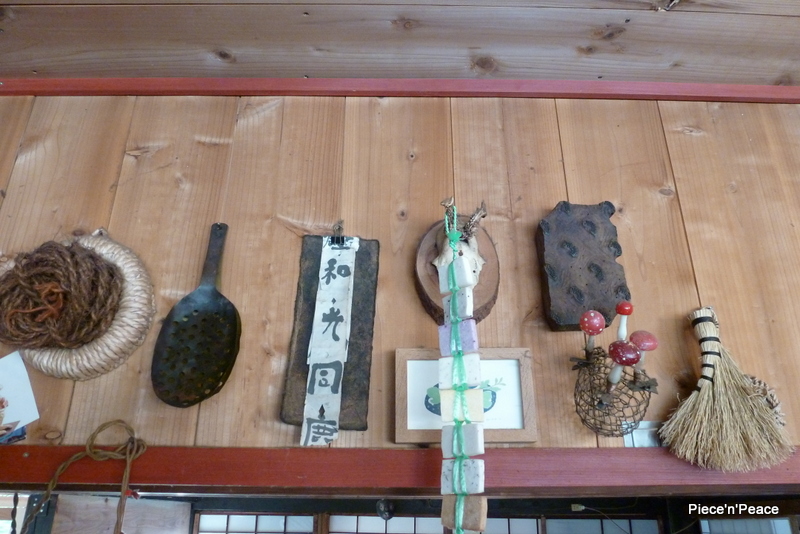
Every corner of the house was filled with a treasure to enjoy, a scene to delight the senses:
Beautiful glass work in the windows
and on the stairs
Sometimes we chose to work upstairs,
and hide from the rain and the thunder
Sometimes the sun shone and we worked outside
We marvelled at the looms and wonderful pieces of textile-related gorgeousness around the house
Those of us in need of a massage could enjoy the electric chair
but my favourite chair was really Snoopy's and everytime I moved she would reclaim it
Thank you Bryan, we felt so welcome, we moved in, took over your home and had a fantastic time.
Subscribe to:
Posts (Atom)